
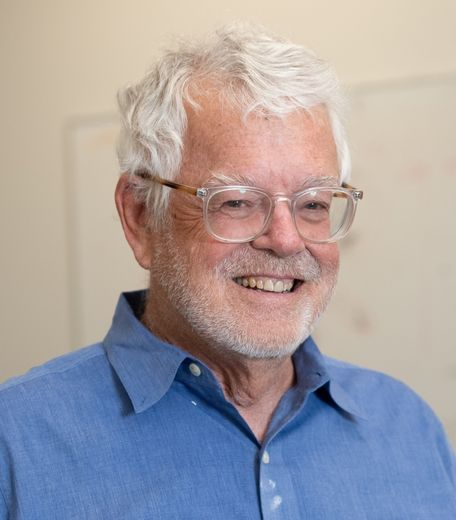
BIO
Allan H. MacDonald (Antigonish, Nova Scotia, Canada, 1951) holds a BSc in Physics from St. Francis Xavier University (Nova Scotia, Canada) and an MSc and PhD on the same subject from the University of Toronto. During his time as a postdoctoral researcher and research scientist at the National Research Council Canada in Ottawa (1978 to 1987), he spent a year as a visiting scientist at the Swiss Federal Institute of Technology in Zurich (ETH Zurich), Switzerland. In 1988, he worked in an advisory capacity at the Max Planck Institute for Solid State Research in Stuttgart (Germany). A Professor of Physics at Indiana University (United States) between 1987 and 2000, he next joined the faculty of The University of Texas at Austin, where he holds the Sid W. Richardson Chair in Physics. His research has resulted in over 1,000 publications with some 110,000 citations, as well as three granted patents. A member of the Condensed Matter Division executive committees of both the Canadian and the American Physical Society, he has also served on a number of advisory boards, including those of the Canadian Institute for Advanced Research and the Kavli Institute for Theoretical Physics.
CONTRIBUTION
In 2011, MacDonald predicted an unusual property of graphene, a material composed of a single layer of carbon atoms. By his calculations, on rotating one graphene sheet on top of another to a very precise angle, the electrons (which in conventional materials move at thousands of kilometres per second) would lose velocity, coming practically to a standstill. This dramatic slowdown raised the possibility of huge changes in the graphene’s behavior of a nature MacDonald could barely imagine when his results first appeared in Proceedings of the National Academy of Sciences. The researcher gave the name “magic angle” to this 1.1º misfit between the graphene layers. Seven years later, Jarillo-Herrero and his team provided the experimental confirmation of this prediction.
His pioneering work provided the theoretical grounding of a field now known as twistronics, where superconductivity, magnetism and other properties are achieved by rotating novel two-dimensional materials such as graphene, with potential technological applications.
