
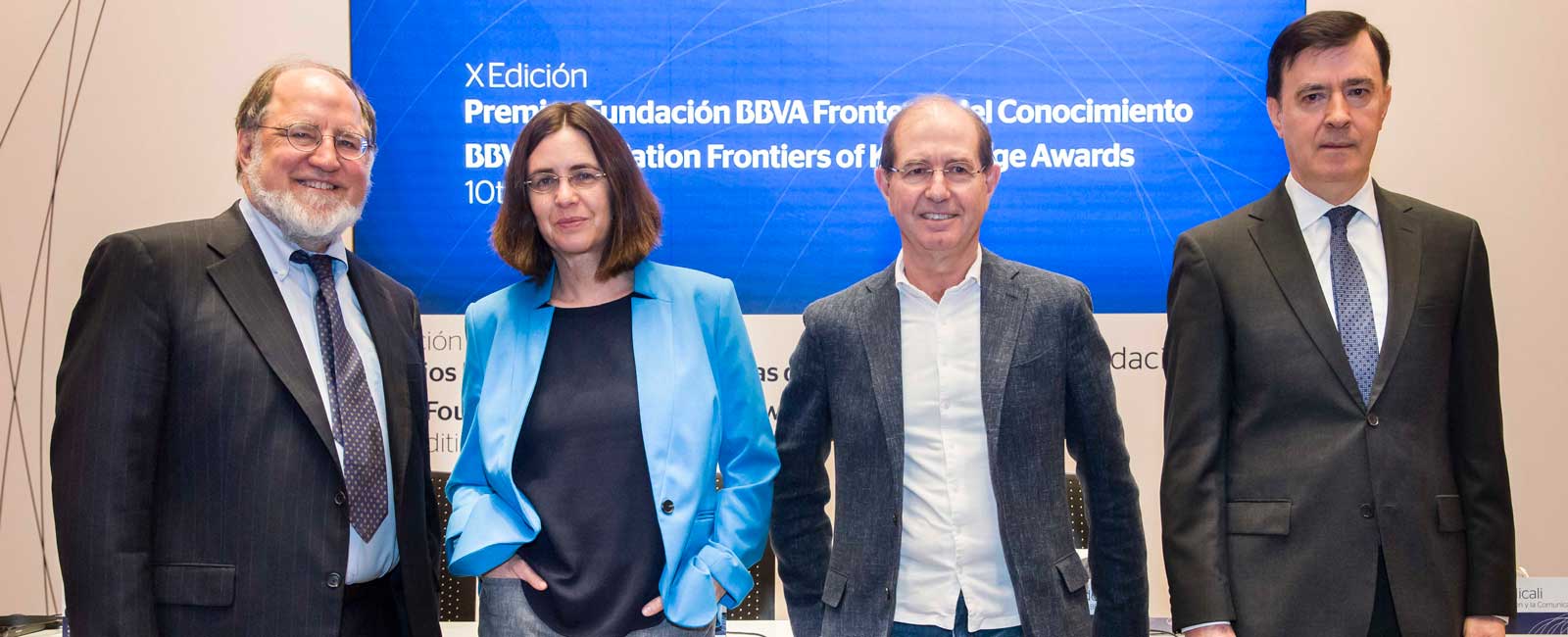
Goldwasser, Micali and Rivest discuss how to protect citizens’ security in the digital society without compromising privacy
The question of how far we can go to preserve citizens’ security without compromising their privacy has no easy answer: not even for the foremost authorities in cryptography. Shafi Goldwasser, Silvio Micali and Ronald Rivest, the three researchers distinguished with the Frontiers of Knowledge Award in the Information and Communication Technologies category, along with Israeli colleague Adi Shamir, engaged in a lively discussion this morning at a press conference prior to wednesday’s award presentation ceremony in the BBVA Foundation.
13 June, 2018
The three are professors at Massachusetts Institute of Technology (MIT) in the United States. The award jury referred to them informally as “the guardians of privacy in the digital age.”
For Goldwasser and Micali, cryptography offers reliable solutions to protect our personal data, while allowing law enforcement agencies to access them on a special-case basis, such as, for instance, intervening against a terrorist organization. “I am less optimistic,” says a more cautious Rivest, adding that “this is an active debate that will run for some time, because this is a complex, global problem. And, frankly, I see no solutions on the table that would allow us to decrypt messages to catch criminals without compromising everyone’s privacy; we are still a long way from that possibility.”
Goldwasser gives examples on how things might be done: “There are mathematical tools that would enable the police to access my key [to read my encrypted information] in determined situations”; for instance, if the encrypted message was a photograph featuring a listed terrorist.” The key could even be broken down – Micali adds – and the pieces distributed to trusted institutions, so it could only be reconstructed in special cases. Rivest, however, remains unconvinced: “We could go on and on with this discussion …”.
