
BIO
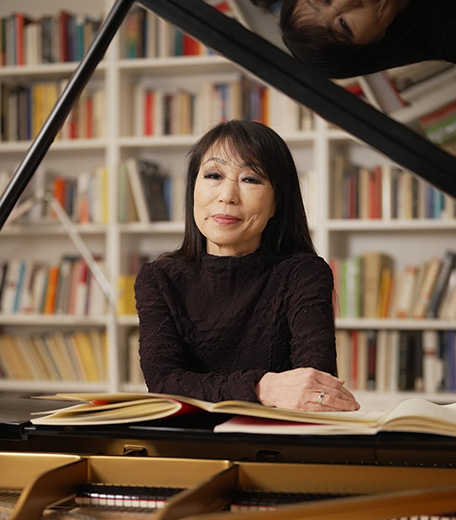
Unsuk Chin (Seoul, South Korea, 1961) studied composition at Seoul National University with Sukhi Kang. In 1985, her graduation piece—the work Spektra for three cellos—won the International Composers’ Competition of the Gaudeamus Foundation, based in Amsterdam, and she received a scholarship that allowed her to move, that same year, to Hamburg, where she studied for three years with György Ligeti at the Hamburg University of Music and Drama. In 1989 she began working as a freelance composer at the Electronic Music Studio of the Technical University of Berlin, the city where she has lived ever since. She has composed more than fifty works in virtually every genre, which very early on attracted the interest of international ensembles and institutions. Thus, in 1992, the Ensemble Intercontemporain of Paris selected her to write *Fantasía mecánica*, which would become the first in a series of six pieces commissioned by this iconic ensemble. Also from that decade are ParaMetaString, commissioned by the Kronos Quartet, and Miroirs des temps, commissioned by the BBC for the Hilliard Ensemble and the London Philharmonic Orchestra, to which, over the years, would be added works commissioned by the Southbank Centre in London, the German Symphony Orchestra Berlin, and the Los Angeles Opera.
From 2006 to 2017, she served as composer-in-residence with the Seoul Philharmonic Orchestra, during which time she founded and oversaw the orchestra’s contemporary music series. In 2010, Esa-Pekka Salonen appointed her artistic director of the London Philharmonia Orchestra’s “Music of Today” series, a position she held for nine seasons. Several contemporary music festivals have dedicated programs to her music, including MITO Settembre Musica in Italy, the Festival Musica Strasbourg in France, the MADE Festival in Sweden, the Festival of the Royal Northern College of Music in Manchester, UK, and the Lucerne Festival in Switzerland. His music has been conducted—and in many cases premiered—by Kent Nagano, Sir Simon Rattle, Gustavo Dudamel, and Mirga Gražinytė-Tyla, among others.
CONTRIBUTION
Chin’s “singular technique creates ever-shifting soundscapes, where color and texture play a central role,” birthing an aesthetic style that is without parallel in today’s music scene. The committee also described her work as drawing on “philosophical and scientific concepts” along with “surrealist literature and the visual arts.”
From her prolific catalogue, they singled out her concertos and her operas, hailed for “expanding the use of the voice through extended techniques, fragmented writing, and abrupt contrasts between sung and spoken text.” The result is a vocal music that is “highly expressive and sinuous” building a “kaleidoscope of moods.”
Her work, in sum, “is characterized by her refined command of sound and masterful ability to transform it into a play of illusions and metamorphoses, marking her out as one of the great innovators in contemporary music,” whose music “has found a place on the stands of the world’s foremost orchestras and performers.”
