
BIO
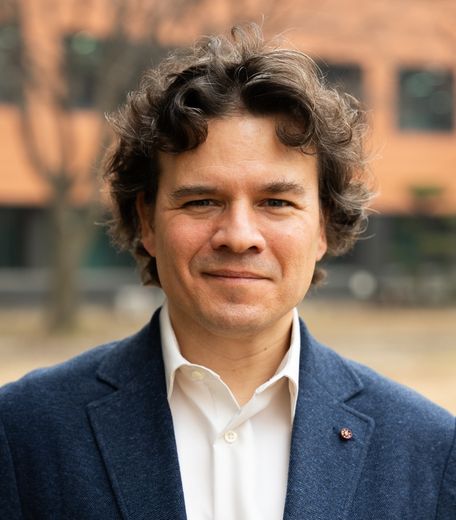
Pablo Jarillo-Herrero (Valencia, Spain, 1976) completed a BSc in Physics at the University of Valencia (1999) and an MSc in Physics at the University of California, San Diego (2001), before going on to earn a PhD at Delft University of Technology (Netherlands) in 2005. After working as a Nano Research Initiative Fellow at Columbia University (United States), in 2008 he joined the Massachusetts Institute of Technology, where he now holds the Cecil and Ida Green Chair in Physics. With over 160 publications to his name, he has been listed as a Highly Cited Researcher (Clarivate Analytics-Web of Science) uninterruptedly since 2017. Jarillo-Herrero has delivered over 300 lectures, holds four patents, and is a Distinguished Visiting Professor at ICFO – The Institute of Photonic Sciences (Barcelona, Spain). Among his other positions at MIT, he is Co-Director of the MIT Quantum Initiative, Associate Director of the Research Laboratory for Electronics, and a member of the Executive Committee of the Center for the Advancement of Topological Semimetals. He is also the founder and organizer of Rising Stars in Physics Workshops, academic career workshops for women held at MIT, Stanford, Princeton, Berkeley, and Columbia.
CONTRIBUTION
From his laboratory at MIT, Jarillo-Herrero led the experimental confirmation of the extraordinary behaviour revealed by graphene when two of its layers are rotated on top of each other at an angle of 1.1º. The existence of this “magic angle” had been predicted seven years earlier by Canadian theoretical physicist Allan MacDonald, who gave it its name.
Writing up his results in two Nature papers of 2018, Jarillo-Herrero described how magic-angle graphene can become either insulating or superconducting, and that it is possible to tune its behaviour with unprecedented precision. His contribution became the most cited of the year in all areas of knowledge, not just in Nature but in all the journals within its publishing group. With the technique his team developed, layers of two-dimensional materials can now be stacked at any chosen angle, giving rise to all kinds of novel properties.
His pioneering research kicked off experimental work in a new field now known as twistronics, where superconductivity, magnetism and other properties are achieved by rotating novel two-dimensional materials such as graphene, with potential technological applications.
